

THE INTERVIEW: GOOD TASTE

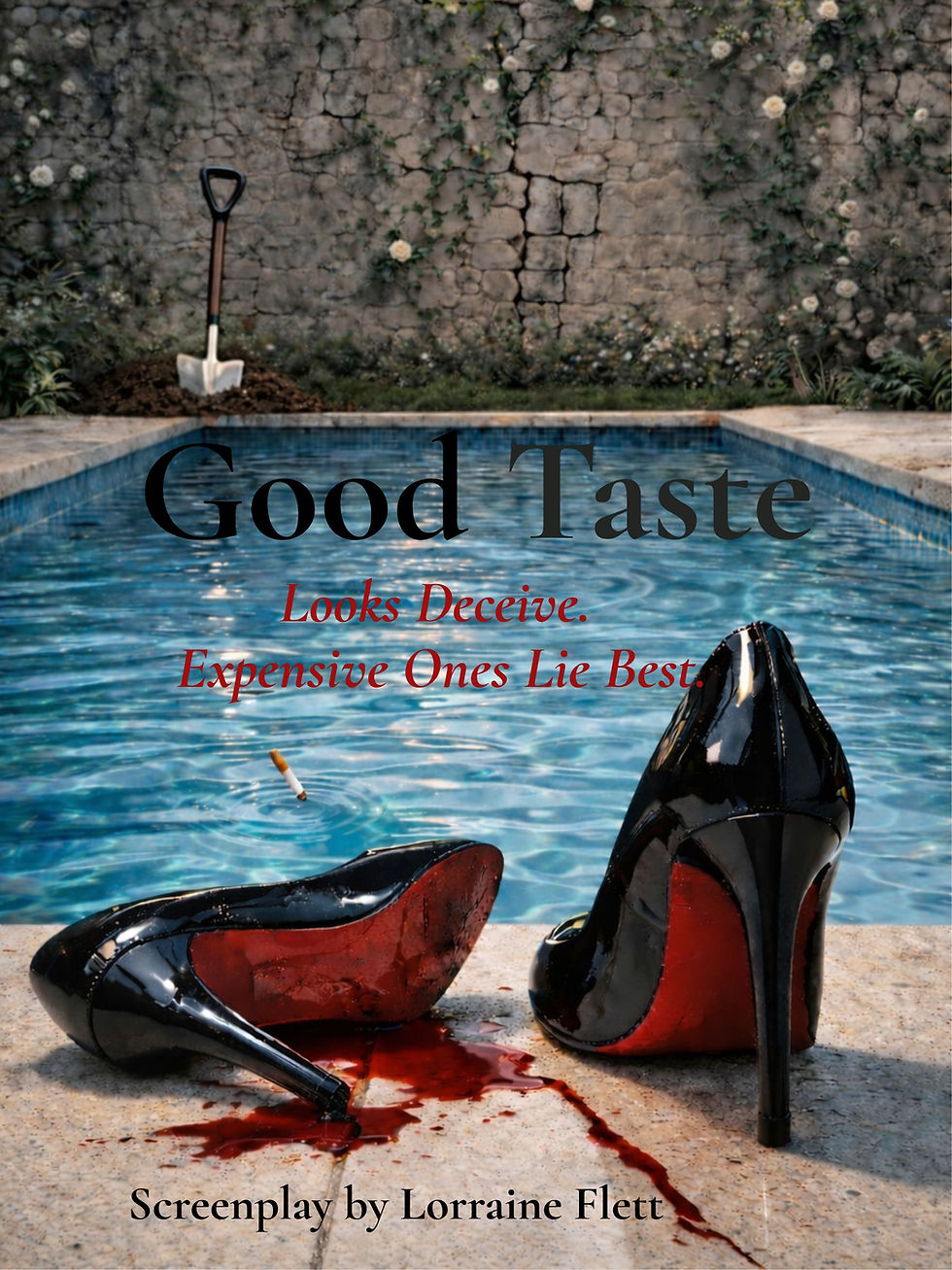
When a reckless rich daddy’s girl dies in her own pool, her gay best friend covers it up, assumes her identity, and turns her failing gallery into a success while deceiving her controlling father and dangerous lover.
What inspired Good Taste?
After seeing Maggie Gyllenhaal’s The Bride!, I wanted to write something daring. I loved the irony of Mary Shelley inhabiting the body of what would become her own creation and going on a wild ride with her own male protagonist Frankenstein.
Then the friend I’d watched the film with told me a story. He had gorged on brownies not knowing they were edibles. A bad trip ensued. He hallucinated turning into the woman who had given him the potent chocolates. The irony was that she is a trans woman.
My screenwriter’s brain went to work. The two ideas converged: identities moving between bodies and, beneath that, everyone wanting the same fundamental things: love and acceptance. I came away feeling creatively electrified and wrote two scripts in quick succession. For this interview, I’m focusing on Good Taste.
How did that become the story of Leo and Clarissa?
First, I asked: Who are these people? How did they get here? What’s their dilemma? More pointedly, what’s the crucible? That’s my starting point. Often, I’ll do a Shazam of my life and conduct a pick-and-mix of people and experiences.
In this instance, I first researched whether an actor could play Leo convincingly as he transforms into Clarissa. Once I satisfied that query, I built the characters as if I were designing a location: their underlying structure, what they’re made of, the surfaces they present, their relationships, and the rooms they choose to inhabit.
Then I decided on the world. My recent scripts are set in San Miguel de Allende, where I live. For this story, I wanted to go bigger. I landed on Mexico City, where I imagine people are always negotiating one thing or another. And what’s more subjective than the value of art?
Still, it wasn’t until I was halfway through the script that I understood what was driving these characters. For Leo, it was the grief and shame of being told he wasn’t good enough to be a dancer. For Clarissa, it was her mother’s suicide. Once I understood those wounds, the story became more than a clever identity thriller.
Leo doesn’t assume Clarissa’s identity simply because he sees an opportunity. He has spent his life feeling second-class. Her death gives him an intoxicating chance to claim the spotlight he was denied. He may not be dancing onstage, but he becomes the star at the center of the art world, adored by the artists he champions, loved by Marco, and finally visible to everyone else.
What is Good Taste really about?
It’s about perception and how readily people believe a lie when it gives them something they want. We live in a time where authenticity is performative. Bathrooms become broadcast studios. Trauma becomes content. Plastic surgery becomes status. Rebellion becomes an aesthetic. What Leo does is extreme, but the people around him are already presenting edited versions of themselves.
Clarissa acts as though she has sovereignty over her life as a Mexico City rebel, but she’s a spoiled rich daddy’s girl. Henry is the guilt-ridden widower and his wife’s murderer. Rafa is a possessive lover under the guise of being protective. Sofia is both arm candy and a Machiavellian opportunist. Even the gallery is two things at once: a cultural space and a machine for creating status.
Leo isn’t the only person pretending. He’s just better at it.
Why is it called Good Taste?
Good taste used to imply discernment, education, restraint, and connoisseurship. Now it is determined by visibility. If something photographs well, sells quickly, or attracts the right people, we assume it has value.
That idea is there from the beginning. Clarissa’s first gallery show is a flop, but Leo points out that the crowd looked good on social media. The event may have failed to sell art, but it succeeded as content. The image travels better than the truth.
The title asks who gets to decide what has value, whether it be a work of art, a face, a public persona, or a human life.
How does the art world reflect the film’s larger themes?
The gallery openings operate like influencer events. People aren’t just buying art. They’re buying access, a story, and the right to say they were there first.
Leo understands that people want what they can’t have, so he creates scarcity and desire. At one show, a man is physically removed after creating a ruckus by demanding to buy a sculpture that isn’t for sale. Leo has manufactured the entire scene, knowing it will gain traction on social media and make people covet the sculpture.
Physical transformation is central to Leo’s deception. What interested you about that?
Practically everyone has some kind of cosmetic work these days, from Botox and fillers to major surgery. That normalization gives Leo the perfect cover. It isn’t in the script, but I imagine that if anyone asked why Clarissa looked different, he would simply answer as her, “Yes, I had a little work done. I’ve never liked my nose.” People would accept it because we already accept altered faces. It also reflects something I believe: people believe what they want to see and see what they want to believe.
While plastic surgery makes Leo look like Clarissa, he doesn’t fully become her. He keeps the scar on his forehead that she inflicted and curates her personality, becoming a nicer version of Clarissa, “nice” being a trait she mocked.
Is there also a love story inside the thriller?
Yes. At its core, Good Taste contains a love story about radical recognition. What matters about Marco is that he sees Leo before, during, and after the transformation and accepts it all.
Their relationship begins with ambition and self-interest. Over time, it becomes loyalty and complicity. I didn’t want their romance to be pure because nothing in this world is pure. For me, love in Good Taste is the person who knows exactly what you've done and still hands you champagne.
Who is the film for, and what would you want audiences to take away from it?
It’s for people who enjoy stylish psychological thrillers, dark humor, sexual tension, and morally ambiguous characters.
First and foremost, I’d want them to have a hell of a cinematic ride. Beyond that, I’d like them to consider whether doing something “bad” can actually be right if everyone benefits. In this case, almost everyone. Henry is the exception, arguably the Mary Shelley figure in this tale, forced to face the “monster” he helped create.
I’d also like them to question how perception shapes their own value judgments.


Comments