

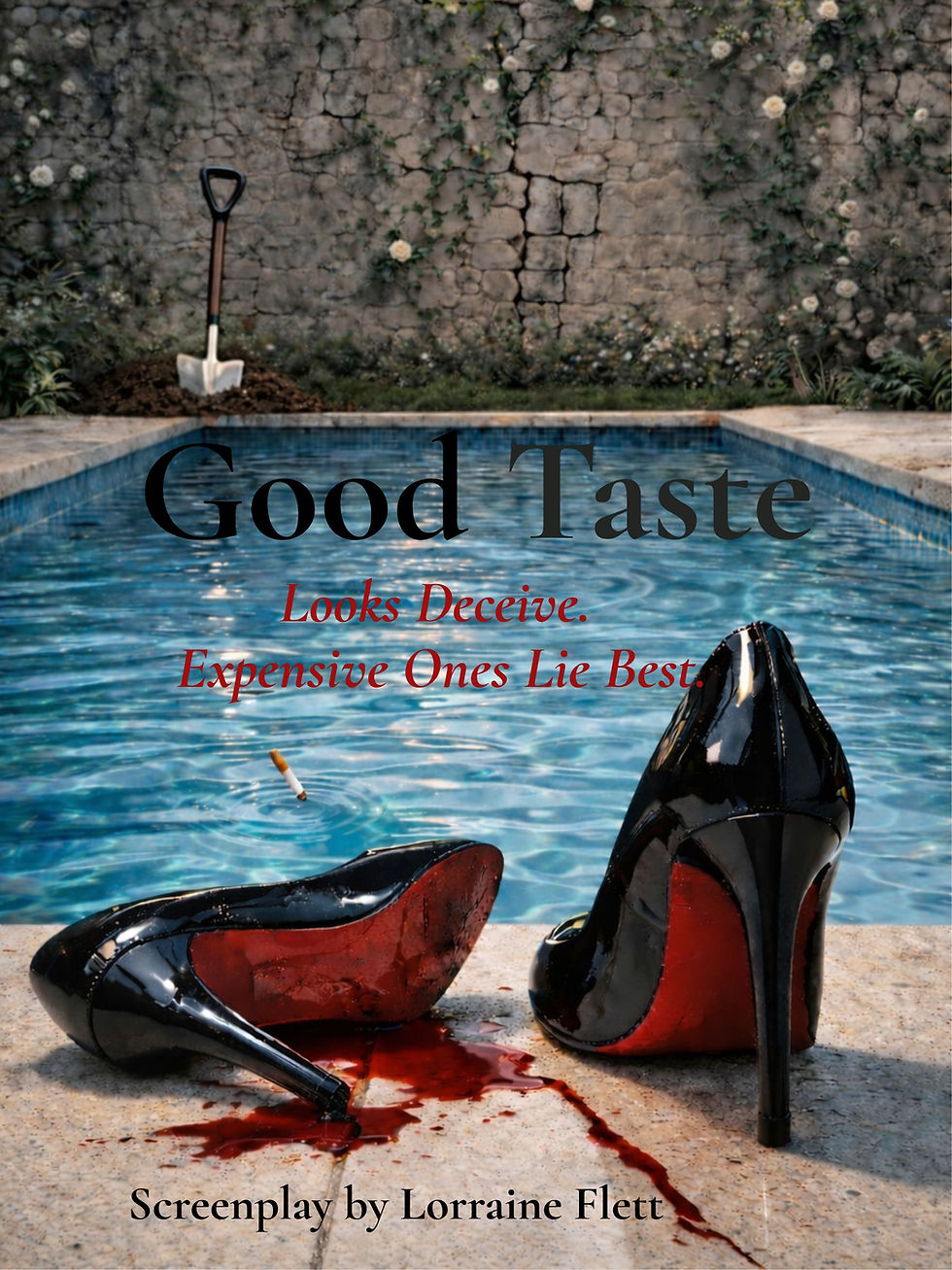
Good Taste — or Who Decides

The International Screenwriters' Association recently wrote: if you can't answer a few basic questions about your script, the conversation with a producer is over.
Not stalled. Over.
So here are mine for Good Taste.
Who is the audience for this?
Audiences who responded to Ripley, Saltburn, and Parasite. LGBTQ audiences hungry for stories where queer and trans identity drives the narrative rather than defines it.
What are the comp titles?
The Talented Mr. Ripley is the obvious one. Identity theft as aspiration. There's also Saltburn — that fixation on access, on proximity to a certain kind of life. And a touch of Parasite in the way class operates quietly, structurally, without announcing itself.
Good Taste goes further. The protagonist doesn't steal an identity — he grows into one. The transformation is biological and surgical. That's not theft. That's evolution.
Why is this story relevant right now?
My kings of cool were Steve McQueen and Paul Newman. My icons were Faye Dunaway, Audrey Hepburn, Jessica Lange, Elizabeth Taylor. Taste had style and class. Now women get dressed for audiences while delivering pithy #MeToo messages and are called influencers. I'm not judging. Just observing.
When I worked in the marketing research department of Sega, we were always asking who defined style, where was ground zero. It was always the street. That's why the film moves the way it does, from the luxury spaces the wealthy occupy in Polanco and Roma Norte to the studios and bars of Tepito and Doctores, where gatekeepers decide who gets in. That's the irony. High to low and back again. All part of the same illusion. Everything is perception. You believe what you want to see. We see what we expect. Good Taste runs on that.
Ingrained in my DNA is whether a story I hear can be made into a movie. So, when a friend told me about a bad trip in which he imagined becoming the woman who'd dosed him — and she used to be a he — I knew there was a story there. The Talented Mr. Ripley immediately came to mind, but why limit it to a man stealing another man's identity?
Then I saw Maggie Gyllenhaal's The Bride. The irony of a dead author becoming the bride of her own male protagonist, post-mortem, was sheer brilliance. Identity doesn't just transfer. It mutates.
That was the crack in the door. Good Taste walked through it.
How do we position this to buyers?
Mexican Ripley with a trans protagonist. That's the one-line pitch.
What does this script say about me as a writer?
Something sparks my curiosity and I follow it, asking “what if” until I have my premise and theme. Then comes structure. Tucked inside Good Taste is a love story. Will he still love me when I'm not the image he fell in love with?
That question belongs to my protagonist. It also belongs to everyone who has ever reinvented themselves and wondered if the people they love will follow them there.
Good Taste is available upon request.


Comments